
Clinical Research Strategic Delivery Standards
Standards for how sponsors and multisite clinical research corporations (MCRCs) measure quality and run strategic partnerships.
They are the culmination of months of industry research and collaboration between regulators, sponsors, CROs, and MCRCs.
Developed With
- Alcanza Clinical Research
- AMR Clinical
- Boehringer Ingelheim
- Centricity Research
- DM Clinical Research
- Duke Clinical Research Institute
- Evolution Research Group
- FDA
- Gilead
- GSK
- Javara
- K2 Medical Research
- MedEvidence!
- Merck
- Novo Nordisk
- Objective Health
- Panthera
- Paradigm
- Pfizer
- Rovia Clinical Research
- Sanofi
- Takeda
- Velocity Clinical Research
Introducing Strategic Delivery Standards
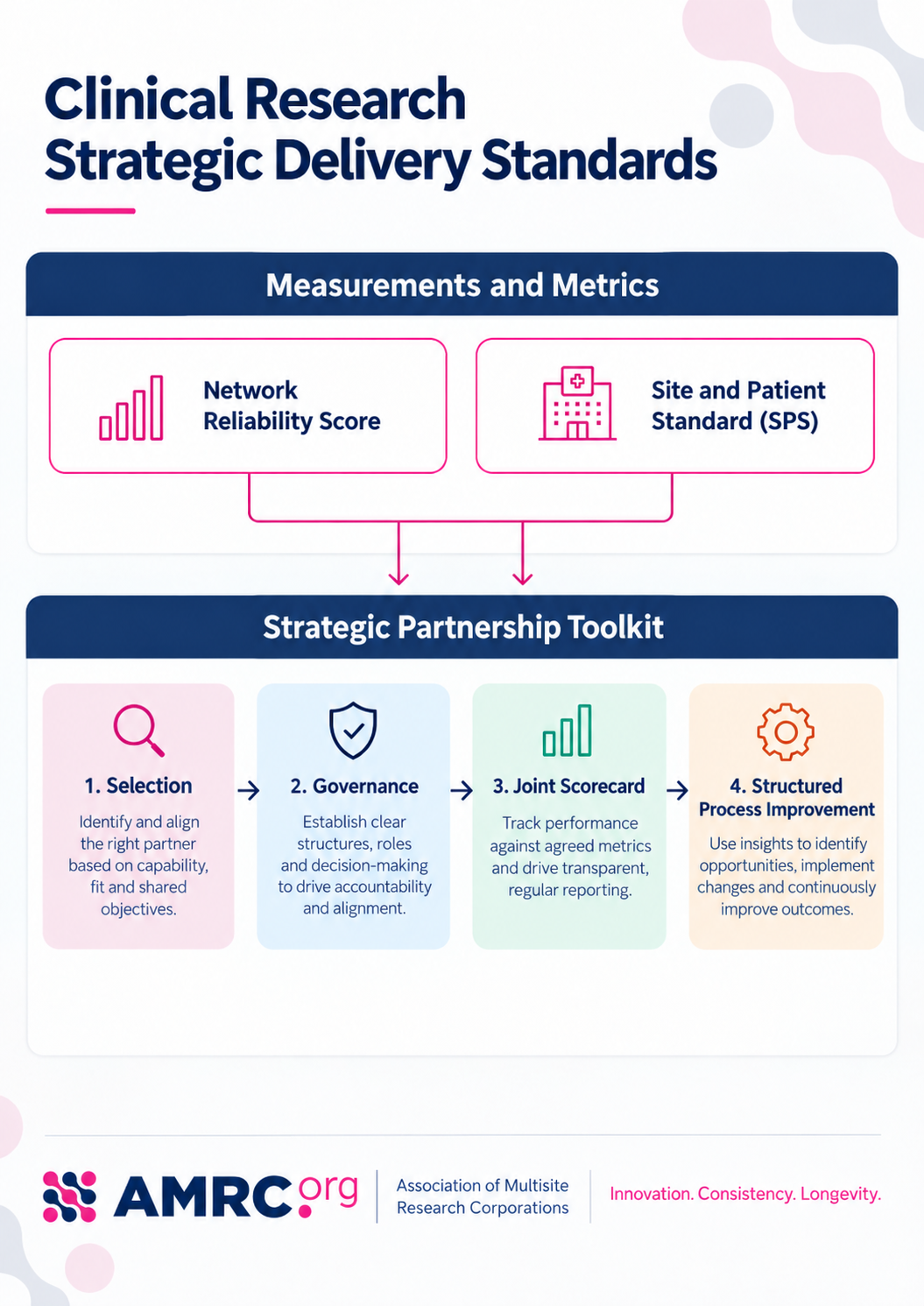
The Strategic Delivery Standards exist to ensure consistency across the industry, defining a shared standard for quality, a toolkit to assess whether a sponsor-MCRC relationship should be strategic, and a structure for running a truly strategic partnership.
The standards are split into three distinct parts, so organizations can choose the sections and workflows best suited to their business.
Three Components
The Strategic Delivery Standards are intended to be flexible and inclusive of different site types, CROs and sponsors. They have been split into three core components to allow users to focus on the sections most relevant to them.
All three components are free to download and use.
-
Part I
Network Reliability Score
This score covers the systems and processes an MCRC uses to make delivery predictable and data quality consistent across its network. Sponsors and MCRCs can use it from first selection through to ongoing partnership governance.
It scores five KPIs, weighted equally: activation timeliness, enrollment delivery, patient retention, CAPA recurrence rate and staff retention.
- Explainer Coming soon
- Scoring Template Coming soon
-
Part II
Site Performance Standard
This standard measures how individual sites perform for patients. It tracks first patient in, the recruitment funnel from patient ID to randomization, retention, screen failure rate, and patient diversity by age, sex and ethnicity.
- Explainer Coming soon
- Scoring Template Coming soon
-
Part III
Strategic Partnership Toolkit
These templates help a sponsor and an MCRC decide whether their relationship should become a strategic partnership, then govern and measure it once it does.
How the Toolkit Works
A strategic partnership asks more of both sides than a trusted vendor relationship. Both communicate openly and hold each other accountable, and each brings something the other can't get elsewhere.
-
Selection Framework
Each side scores the relationship on its own, then the two compare results. The sponsor assesses the MCRC against seven criteria, and the MCRC assesses the sponsor. An average of 4.3 or above marks a strategic partner.
-
Governance Structure
A Governance Committee of senior leaders owns the relationship, and an Operations Committee runs it day to day. Smaller partnerships can merge the two into one steering committee.
-
Performance Management
Both sides report against a joint scorecard of shared metrics, from study startup to relationship health. The Operations Committee reviews it each quarter, and every metric has a named owner.
-
Structured Process Improvement Cycle
The Operations Committee picks one or two areas to improve and works on them in six-month cycles. Post-study reviews feed the next cycle, with MCRC input built into protocol design.
-
Questions About the Standards?
Email the AMRC team at info@amrc.org.